
Introduction
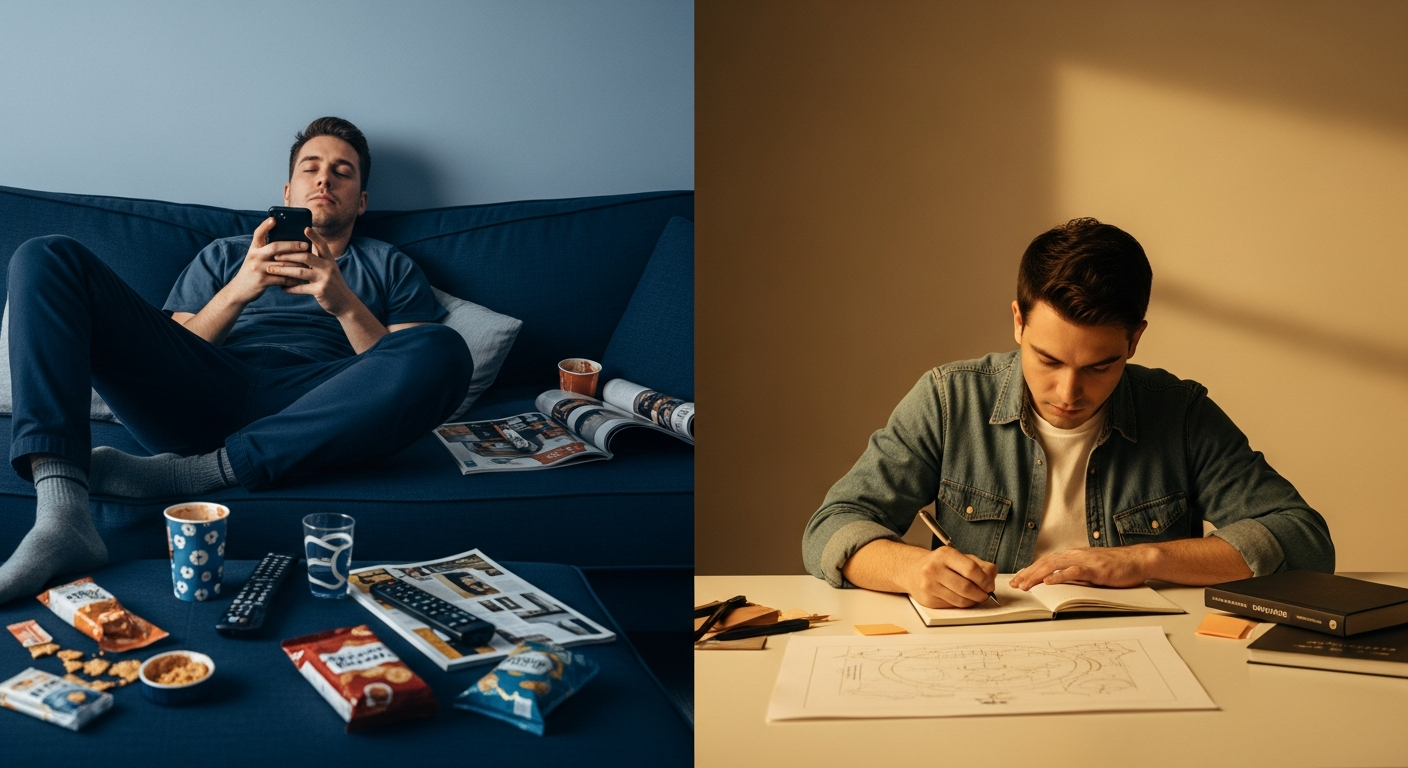
You know you should work on the important project. However, your brain whispers: “Just check your phone first.” Subsequently, you’re scrolling, watching videos, or browsing—anything but the work. Meanwhile, hours disappear. The work remains unfinished.
This isn’t laziness or lack of discipline. Rather, it’s your nervous system seeking stimulation. Your important work feels boring by comparison to the constant stream of novel content. Therefore, your brain chooses the stimulation. Additionally, once you notice the distraction, it’s usually too late—you’re already pulled in.
This is comfort and stimulation distraction. It’s perhaps the most powerful procrastination trap because it’s neurologically addictive. Consequently, breaking free requires understanding your nervous system and deliberately building your capacity for boredom.
The Stimulation Craving
Your Overstimulated Nervous System
Your environment is engineered for stimulation. Therefore, your nervous system is constantly activated. Notifications ping constantly. Content streams endlessly. Information flows immediately. Notably, your brain has adapted to this constant stimulation. Therefore, normal work feels dangerously boring by comparison.
When you sit down to do meaningful work, you experience understimulation relative to what you’re accustomed to. Consequently, your nervous system rebels. It seeks stimulation. Additionally, pulling up your phone or switching to social media provides instant neurological relief. Moreover, the relief feels justified because stimulation feels like it might be work-related.
The Dopamine Trap
Stimulation delivers dopamine. Therefore, your brain learns: “Distraction = dopamine.” Consequently, when you need focus, your brain actually craves distraction because distraction is your reliable dopamine source. Additionally, important work—which is meaningful but not immediately stimulating—doesn’t trigger the same dopamine response.
This is why willpower alone doesn’t work. You’re not fighting laziness—you’re fighting neurochemistry. Moreover, your brain has been trained to associate dopamine with distraction. Therefore, willpower battles neurology and usually loses.
The Comfort Trap
Why Difficult Feels Threatening
Important work is often difficult. Therefore, it triggers your threat response—the nervous system activates as if danger is present. Additionally, difficult work requires sustained focus, which creates discomfort. Moreover, your brain interprets this discomfort as something to escape. Consequently, comfortable distractions feel like safety.
This is why people describe procrastination as “comfort seeking” rather than laziness. Your nervous system is seeking safety, not laziness. Therefore, comfort distractions aren’t indulgences—they’re survival mechanisms in your nervous system’s understanding.
The Comfort-Avoidance Cycle
When you feel uncomfortable during work, you distract yourself with comfort. Subsequently, the discomfort disappears. Therefore, your nervous system learns: “Discomfort triggers distraction, distraction eliminates discomfort.” Importantly, this pattern reinforces itself. Each time you distract from discomfort, you strengthen the neural pathway.
Consequently, over time, you become increasingly intolerant of discomfort. Additionally, difficult work becomes increasingly triggering. Moreover, you require increasing amounts of distraction to manage the discomfort.
Breaking The Stimulation and Comfort Loop
Step 1: Recognize What You’re Actually Craving
When you reach for distraction, pause. Specifically, ask: “Am I bored? Uncomfortable? Overstimulated?” Notably, identifying what you’re actually craving helps you address it directly. Additionally, sometimes you need actual stimulation—a brief break, a walk, or music. However, scrolling social media isn’t the answer.
Step 2: Build Boredom Tolerance
Your capacity for boredom has atrophied. Therefore, building it back requires practice. Specifically, sit with discomfort for five minutes without distraction. Subsequently, increase this to ten minutes. Moreover, each time you tolerate boredom, you strengthen your capacity. Importantly, the discomfort decreases as your tolerance builds.
Step 3: Create Boundaries Around Stimulation
Turn off notifications entirely, not just during work time—actually turn them off. Additionally, remove obvious distractions from your workspace. Moreover, use app blockers that actually prevent you from accessing time-sink sites. Importantly, these barriers are crucial because willpower battles neurochemistry. Consequently, environmental design beats willpower.
Step 4: Offer Alternative Stimulation
Rather than white-knuckling through boredom, offer your nervous system legitimate stimulation. Specifically, listen to music while working. Additionally, work in a coffee shop with ambient stimulation. Moreover, use the Pomodoro technique with movement breaks. Importantly, these alternatives satisfy your stimulation need without derailing your work.
The Producer’s Relationship With Boredom
Producers Can Focus Without Constant Stimulation
Producers have rebuilt their capacity for sustained focus. Therefore, they can engage meaningful work without needing constant novelty. Additionally, they recognize that deep work feels different from shallow stimulation. Notably, they value the difference. Moreover, they’ve learned that meaning provides satisfaction that stimulation never does.
Comfortable Discomfort Becomes Productive
This is counterintuitive: producers become comfortable with the discomfort of difficult work. Therefore, they no longer interpret it as a threat. Additionally, they recognize discomfort as evidence they’re engaged in meaningful work. Moreover, they’ve developed enough distress tolerance to stay focused despite discomfort.
From Stimulation Addiction to Sustained Focus
Breaking free from comfort and stimulation distraction requires rebuilding your nervous system’s capacity for sustained focus. Additionally, it requires recognizing that boredom tolerance is a skill you can develop. Therefore, it’s not about willpower—it’s about training.
This training happens through small, consistent actions. Specifically, sitting with boredom for brief periods, removing obvious distractions, creating environmental structure, and offering appropriate stimulation. Moreover, over weeks and months, your nervous system adapts. Additionally, you discover that meaningful work provides a different kind of satisfaction than stimulation ever did.
The work matters. Therefore, it’s worth rewiring your nervous system to focus on it.
[Call-to-Action Button: “Create Your Focus Environment”]
Follow me on Instagram: Click Here

free download
Want To Feel More Confident About Getting Things Done?
Grab this FREE guide that will help you break free from procrastination and boost your productivity!